


Chernobyl was a Soviet catastrophe. Germany’s reaction turned it into a long-term domestic one. Drawing on UN data and a recent report by WePlanet DACH, we argue that the nuclear phase‑out not only failed on its own terms: it drove up emissions, imposed real costs on workers and households, and produced large‑scale unintended consequences. If climate policy is to be taken seriously, it must be based on evidence rather than political reflexes.
Electricity systems combine different sources of low‑carbon power – from nuclear to wind and solar. Credit: Image: Shutterstock / jaroslava V
At the time of the Chernobyl nuclear accident, we were at very different stages of our lives: Vero was a first‑year university student, while Amardeo had a young family with three small children. We were caught off guard by the intensity of the German reaction. The huge media reaction frightened us. The first coalition government in Hesse consisting of the SPD and the Greens reacted dramatically by imposing a limit of 20 Bq/L for milk, which was well below both German and international standards. Amardeo used his holiday allowance to escape the perceived danger with his family by visiting his parents in Cameroon. Vero joined the German anti-nuclear movement, from which she later distanced herself in the wake of the climate debate and her own research on nuclear safety.
Looking back, this was an understandable emotional reaction. But was it rational? Time has passed, and we now have a much clearer idea of what happened. It was a terrible disaster, but Germany clearly overreacted. We went along with that overreaction. Today, the question is: what do UN bodies and other non‑activist assessments tell us?
Why Chernobyl happened
At the time of the Chernobyl accident, the Soviet nuclear industry was a regime of command and control, strict obedience and strict secrecy. Self-criticism and open discussions of mistakes were hardly possible. In the 1980s, the kind of human factors management common today did not yet exist. It was left to individual supervisors’ discretion to determine how much “questioning attitude” was permitted and whether mistakes would lead to learning or to punishment and cover-up. This was one of the systemic conditions that led to the Chernobyl disaster on April 26, 1986.
A functional test on the electrical systems of the fourth and newest unit at the Chernobyl power plant triggered an unfortunate chain of events that caused the facility to spiral out of control. A nuclear power excursion destroyed the reactor building, and the highly radioactive contents of the reactor core were carried across Europe by early‑summer south‑easterly winds. The accident thus became a transnational catastrophe that sparked political upheaval and efforts at nuclear reform far beyond the site itself.
The Consequences
Around 30 people died in the days and weeks following the accident, and in total, between 50 and 60 deaths can be clearly and directly attributed to the radiation released at Chernobyl. Most of those who died were power plant employees, first responders and firefighters whose selfless efforts likely helped to prevent even worse consequences.
The WHO and other UN bodies estimate that the long‑term consequences for the most highly exposed groups could amount to around 4,000 additional cancer deaths, although this figure is uncertain and cannot be observed directly in epidemiological data. Between April 1986 and 1995, an area of around 2,600 square kilometres in the north‑west Kyiv area, together with large regions in southern Belarus and western Russia, was evacuated; in total, approximately 170,000 people lost their homes and almost all their possessions. Various assessments put the total economic damage caused by the accident at around €170 billion.
The most clearly established long‑term health effect is an increased incidence of thyroid cancer among young people living in the most contaminated regions. Several thousand cases have been diagnosed, and a significant proportion of these are attributable to radiation from the accident, although the exact number remains uncertain. Although thyroid cancer is a serious diagnosis, the prognosis is generally good, and many cases are treatable with appropriate care. UN reviews conclude that, for most of the population in the affected countries, radiation doses were low enough that no detectable increase in radiation‑related disease is expected. People, therefore, do not need to live in constant fear of serious health consequences from Chernobyl.
Investigating Chernobyl in the Soviet Union
Around 600,000 people from across the Soviet Union were involved in the “liquidation” of the accident – the Soviet Union’s last major joint effort before its dissolution five years later. The response to the accident echoed the fight against Germany in the Second World War, and the symbolic language used in the years immediately afterwards was deliberately modelled on wartime imagery.
Initially, the Soviet leadership fell back into old patterns of behaviour, despite the reform rhetoric of the new party leader, Mikhail Gorbachev. In the initial days, the accident was kept secret until radiation measurements in Scandinavia pointed to the Chernobyl nuclear power plant as the source of elevated levels, forcing Moscow to admit what had happened. Even then, the population was largely kept in the dark about the consequences of the accident: the measures taken were not explained, and no measurement data were published. There was little “nuclear literacy” among the public – and even among medical personnel – meaning that there was a lack of reliable knowledge about radioactivity, how to deal with contamination and what health effects could be expected. As a result, rumours and prejudices spread, making life after Chernobyl even more difficult. Evacuees were shunned by their new neighbours as if they were spreading a contagious disease, and thousands of women were urged to terminate their pregnancies even though this was medically unnecessary in most cases.
Meanwhile, at the Chernobyl nuclear power plant, a state investigative commission sought the causes of the accident but initially produced only a whitewashed version of the facts that aligned with the government’s agenda. Culprits were sought and found to avoid having to question the Soviet nuclear industry system. A number of scapegoats from the plant management and the Chernobyl operating crew were sentenced to harsh prison terms in a show trial. The version attributing the accident to “human error” and mistakes by plant management was also presented to the International Atomic Energy Agency (IAEA) at its conference in the summer of 1986 and recorded in the IAEA’s first Chernobyl report.
It was not until four years later, shortly before the collapse of the Soviet Union, that a newly appointed investigative commission submitted a report (IAEA INSAG‑7) identifying the systemic causes of the accident. The graphite‑moderated, water‑cooled RBMK reactor, a Soviet design that had previously enjoyed high prestige as the country’s “national reactor”, turned out to be structurally flawed. The large core of RBMK units was susceptible to significant neutron-flux instabilities. Because the reactor used graphite as a moderator and light water as a coolant, it had a positive void coefficient of reactivity: increased steam bubble formation in the boiling coolant raised reactor power instead of reducing it, unlike in water-moderated reactors. This effect was particularly pronounced at low power and with high fuel burnup – precisely the conditions that prevailed in Unit 4 on the night of the accident.
In addition, design peculiarities meant that the shutdown system had serious safety deficiencies. Not only was it very slow, but in certain operating modes, inserting the control rods caused a brief increase in reactivity. This is why Chernobyl‑4 experienced a catastrophic power surge at the moment of shutdown at the end of the test programme.
The operating crews at the end of the chain of command had been systematically excluded from information about these weaknesses. At the same time, the limited automation of the RBMK’s protection system meant that, shortly before the accident, operators could intervene in ways that created the conditions for the subsequent course of the accident. It later emerged that serious incidents involving fuel-element damage due to physical instabilities in RBMK plants had been documented since 1975, and that commissioning tests had already revealed the reactor’s accident-prone neutron-physical characteristics. Together with the initial cover-up of the scale of the accident, these findings destroyed Soviet citizens’ trust in the state and in nuclear experts. Nevertheless, Chernobyl was the first public disaster in Soviet history to be shown on television, albeit in a censored form.
Chernobyl and Germany
For reasons of reactor physics, the kind of reactivity accident that occurred at Chernobyl cannot happen in Germany’s light‑water‑moderated power reactors. Nevertheless, Chernobyl served as a catalyst for a paradigm shift in the German nuclear industry. First, from then on, beyond‑design‑basis accidents were treated as a real possibility rather than being relegated to the realm of “residual risk”. Second, numerous retrofits were undertaken in German nuclear power plants to prevent or mitigate such accidents. Many of these measures were based on insights that had already been developed before Chernobyl in the German Risk Study on Nuclear Power Plants (1979–1990). In the 1990s, German plant containments were retrofitted with filtered venting systems for severe accidents, hydrogen recombiners, and – in pressurised‑water reactors – additional valves for primary‑side pressure relief.
At the same time, influenced by the post‑Chernobyl debate on the “human factor” in nuclear power plants, operators began to introduce systematic incident reviews, structured work planning and pre‑job briefings – practices that had not previously existed in German facilities. All these communication and planning tools were designed to strengthen the workforce’s “questioning attitude” and to minimise the influence of internal hierarchies and power dynamics on open discussion of errors.
In the public debate, however, there was little room for a “lessons learned” perspective or for a clear distinction between Chernobyl’s RBMK design and a German PWR with its sophisticated, highly automated safety systems. Instead, nuclear energy as such was held responsible for Chernobyl.
Nuclear power gradually became morally associated with evil, especially after 1986. Being anti‑nuclear turned into a core identity marker for much of the German left, and over time this stance was also adopted by parties in the political centre and on the centre‑right. This moral certainty fostered a culture in which only anti‑nuclear narratives were socially acceptable, while any pro‑nuclear argument was quickly branded as serving corporate interests. Many people in politics, academia and the media had good reason to fear for their careers if they were seen as sympathetic to nuclear energy.
In his book Akte Atomausstieg: Das Ende der Kernkraft und das Scheitern der Energiewende (“The Nuclear Phase‑out Files: The End of Nuclear Power and the Failure of Germany’s Energy Transition”), journalist Daniel Gräber uses internal government documents to show how German industry gradually succumbed to growing political pressure and how party‑political goals were often placed above the long‑term interests of the country. German unions and the SPD, traditionally the closest allies of industrial workers and engineers, ultimately abandoned those very groups in the nuclear sector.
Two personal experiences illustrate how far Germany has drifted from other countries when it comes to the treatment of nuclear workers. When we joined the protest against the closure of the Fessenheim plant in France, there was a large local gathering that included the mayor, city councillors and members of the CGT and other trade unions; Amardeo was even asked to give a short statement, offering a rare German pro‑nuclear voice. By contrast, when we later joined a protest at the Philippsburg plant in Germany as it was shut down, it was environmentalists from Poland who had travelled to speak out – unions and local representatives remained conspicuously absent, and workers had been warned not to take part despite the looming loss of their jobs. Workers told us that EnBW management had warned union representatives that if there were any public protests, the severance plan providing financial security for early retirees would be at risk.
While Ukraine, home to Chernobyl, and Japan, site of the Fukushima accident, remain committed to nuclear energy, Germany succumbed to the pressure of this new moral identity and chose to phase out nuclear power. The phase‑out was initiated by the first SPD–Green coalition and then given its definitive form by the CDU/CSU–FDP government in 2011, in the wake of Fukushima.
Countries that suffered major nuclear accidents kept nuclear power in their energy mix. Germany suffered a psychological blackout instead and decided to walk away from one of its safest and cleanest sources of electricity.
Risks of the Phase-out
When discussing the risks of any technology, it is essential to compare them with the risks of doing without it and with the risks of the available alternatives. Otherwise, we cannot know whether our actions produce a net benefit or a net harm.
In the case of nuclear energy, this means looking not only at the risks of accidents, but also at the risks of abandoning nuclear and replacing it with other sources. In Ten Years of Fukushima Disinformation (2021), Anna Veronika Wendland and I cited work by Pushker A. Kharecha and Makiko Sato showing that Japan and Germany together could have avoided around 28,000 premature deaths between 2011 and 2017 if they had phased out coal instead of nuclear power.
A much more comprehensive and up‑to‑date assessment has now been published by WePlanet DACH, in collaboration with the Anthropocene Institute, under the title The German Nuclear Phase-out: The true cost in monery, lives and carbon of Germany’s Atomausstieg. According to this updated 2026 analysis, Germany’s nuclear phase‑out has already led to more than 24,000 additional deaths from air pollution and around 950 million tonnes of extra CO₂ emissions. It has also imposed over €74 billion in extra EU ETS costs – roughly €1,800 per household.
These are not hypothetical accident scenarios but realised harms from burning more coal and gas instead.
This in no way belittles the harm caused by the Chernobyl disaster. Rather, it shows that reacting in panic, or without considering all the consequences, could lead to a different kind of disaster – one that is many times larger, but distributed in time and space and therefore much less visible.
Germany’s Energy Policy Ignores the Evidence
Scepticism in the early phases of nuclear power was understandable. Today, however, we have several decades of experience and enough data to compare all major energy systems. Many of the original fears have not been borne out by the evidence, as I argued in Unmasking the Claims of the Antinuclear Movement: Climate, Health, and Energy at the Crossroads.
Together with Austria, Germany has built an anti‑nuclear identity that is unique among industrialised democracies. In this Central European anti‑nuclear heartland, mass protests from Wyhl to Wackersdorf in Germany shaped the public debate, and a razor‑thin referendum majority in 1978 stopped Austria’s completed nuclear plant at Zwentendorf from ever operating.
Much of the public discussion focuses on climate, the environment and health. So where do we stand on these dimensions? Beyond a sober comparison of accident risks, we must also ask how countries that have chosen to rely mainly on wind and solar for electricity generation have fared. Here, I am not referring to “renewables” in general, since that category includes hydroelectric power, which can provide reliable baseload electricity for an industrial economy.
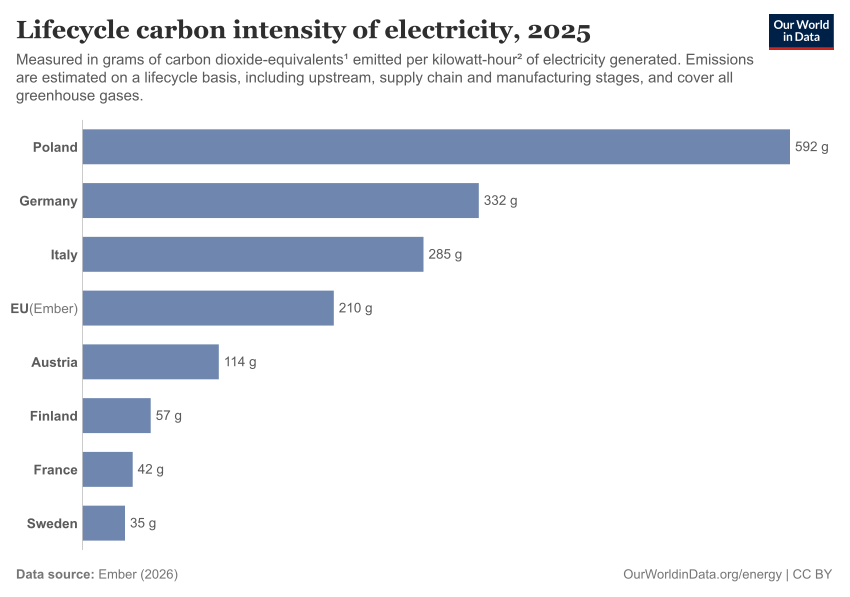
The experience of recent decades tells a clear story for industrialised countries. Those – such as Germany and Denmark – that rely primarily on wind and solar tend to have comparatively high electricity generation emissions and some of the highest consumer prices. By contrast, countries with a large share of firm low‑carbon capacity – whether nuclear, hydro or geothermal – generally fare better on all three fronts: low emissions, more moderate prices and a more reliable power system.
Source: Our World in Data https://ourworldindata.org/grapher/carbon-intensity-electricity
Recent lifecycle data on electricity generation in 2025 confirm this pattern. Germany has one of the highest carbon intensities in Europe, whereas Austria performs somewhat better thanks to its substantial hydroelectric baseload. Both countries still have a higher carbon intensity than France, Sweden and Finland, which rely heavily on nuclear and hydroelectric power. Countries with a heavy reliance on coal, such as Poland, have an even higher carbon intensity, although Poland now plans to reduce this by adding nuclear power to its energy mix in the 2030s.
Yet despite these differences in real‑world emissions and health impacts, Chernobyl remains an emotional instrument of anti‑nuclear politics in countries like Germany and Austria. The disaster is routinely cited to underline the dangers of nuclear power, while careful assessments by UN bodies and scientific reviews of its actual long‑term health effects are largely ignored. In this way, Chernobyl is used not to illuminate the full spectrum of energy risks, but to sustain a political agenda that treats nuclear risk as absolute while ignoring the benefits of nuclear power and the real, statistically greater harms of the alternatives.
These patterns are rarely reflected in German mainstream media coverage and are often downplayed or ignored in political debates. Too many decision‑makers prefer reassuring narratives that avoid uncomfortable evidence.
Organisations such as Global 2000 in Austria actively campaign against nuclear projects in other countries, including attempts to derail planned reactors in Poland. Courts in Germany and at the European level, for their part, often appear to have limited technical understanding of power systems and nuclear safety, and they tend to accord disproportionate weight to the most radical activist positions.
In the meantime, most countries have drawn their own conclusions and are reluctant to copy the German Energiewende. Germany and Austria, however, still invest considerable political capital in trying to dissuade others from choosing a different path, especially if that path includes nuclear power.
Return to Reason
We now face a choice. We can continue down the Austro‑German path of ideologically driven energy policy, or we can return to a more evidence‑based approach – the path most other countries in Europe and around the world have either adopted as official policy or are gradually moving towards.
There is no one‑size‑fits‑all solution that can be applied to every country. Some countries have abundant hydropower or geothermal resources. What we do know is that relying on weather‑dependent wind and solar alone will not suffice for any industrial society. Backup systems are either high‑emission, such as gas, or will not be available at scale for a long time, including the massive investments in infrastructure they would require. For the foreseeable future, therefore, nuclear power will remain necessary as a source of firm low‑carbon capacity wherever hydro or geothermal power is not available at scale.
Returning to reason in energy policy does not mean ignoring risks. It means weighing all risks and harms, including those arising from well‑intentioned but misguided decisions. Countries like Germany are, of course, free to opt for a “renewables‑only” electricity system. However, this is not a responsible option for anyone who takes workers, prosperity and the climate seriously. Excluding nuclear power in advance would put all three at risk, with far more negative consequences than using it.
We write this as people who grew up on the left and still care about its original commitments to workers, engineers and broad‑based prosperity. We also welcome a new generation of environmental movements – such as WePlanet, which we support and have helped to build – that link health and environmental concerns with a commitment to prosperity for all. The question is whether countries like Germany and Austria are prepared to heed this call and return to reason.
References
Official and technical reports
International Atomic Energy Agency (IAEA). 1992. The Chernobyl Accident: Updating of INSAG‑1 (INSAG‑7). Report by the International Nuclear Safety Advisory Group, Safety Series No. 75‑INSAG‑7, Vienna.
WHO/IAEA/UNDP et al. 2005. Chernobyl’s Legacy: Health, Environmental and Socio‑Economic Impacts and Recommendations to the Governments of Belarus, the Russian Federation and Ukraine.
WePlanet DACH & Anthropocene Institute. 2026. The German Nuclear Phase-out: The true cost in monery. lives and carbon of Germany’s Atomausstieg. WePlanet DACH. Available online at: https://weplanet-dach.org/wp-content/uploads/2026/04/The-German-Nuclear-Phase-out-Report-2026.pdf
Kharecha, Pushker A., and Makiko Sato. 2019. How energy choices after Fukushima impacted human health and the environment. State of the Planet (June 17). Available online at: https://blogs.ei.columbia.edu/2019/06/17/post-fukushima-energy-japan-germany/
Articles and chapters by the authors
Sarma, Amardeo, and Anna Veronika Wendland. 2021. Ten Years of Fukushima Disinformation. Skeptical Inquirer 45(2).
Sarma, Amardeo. 2024. Fukushima, Jahr 13: Fakten gegen Desinformation und Mythenbildung. WePlanet DACH. Available online at: https://weplanet-dach.org/fukushima-jahr-13-fakten-gegen-desinformation-und-mythenbildung/
Sarma, Amardeo. 2023. Unmasking the Claims of the Antinuclear Movement: Climate, Health, and Energy at the Crossroads. Skeptical Inquirer 47(1).
Wendland, Anna Veronika. 2019. Nuclearizing Ukraine – Ukrainizing the Atom: Soviet Nuclear Technopolitics, Crisis, and Resilience at the Imperial Periphery. Cahiers du Monde Russe 60(2–3): 335–367.
Wendland, Anna Veronika. 2015. Inventing the Atomograd: Nuclear Urbanism as a Way of Life in Eastern Europe, 1970–2011. In Thomas Bohn, Thomas Feldhoff, Lisette Gebhardt and Arndt Graf (eds.), The Impact of Disaster: Social and Cultural Approaches to Fukushima and Chernobyl, Berlin, 261–287.
Wendland, Anna Veronika. 2016. Tschernobyl: (K)eine visuelle Geschichte. Nukleare Bilderwelten in der Sowjetunion und ihren Nachfolgestaaten. In Melanie Arndt (Hg.), Politik und Gesellschaft nach Tschernobyl, Berlin, 182–210.
Wendland, Anna Veronika. 2020. Ukrainian Memory Spaces and Nuclear Technology: The Musealization of Chornobyl’s Disaster. Technology & Culture 61(4): 1162–1177.
Wendland, Anna Veronika. 2023. Das Kernkraftwerk Zaporižžja: Kriegsschauplatz und Testfall der Reaktorsicherheit. OSTEUROPA 73(10–11): 125–161. Available online at: https://zeitschrift-osteuropa.de/blog/das-kernkraftwerk-zaporizzja/
Wendland, Anna Veronika. 2023. Der Tschernobyl‑Reaktor RBMK – The Chernobyl Reactor RBMK. Jahrbücher für Geschichte Osteuropas 71(1): 137–165.
Books and broader essays
Gräber, Daniel. 2025. Akte Atomausstieg: Das Ende der Kernkraft und das Scheitern der Energiewende. Freiburg: Herder.
Weart, Spencer R. 1988. Nuclear Fear: A History of Images. Cambridge, MA: Harvard University Press.
Weart, Spencer R. 2012. The Rise of Nuclear Fear. Cambridge, MA: Harvard University Press.
If you value free articles like this from Scientific Temper, you can support our work with a donation via PayPal.
There is just not enough water to cool those NPPs down in Europe...
They should have never been shut down in the first place, but since they have been, building new fission NPP is expensive. Fusion reactors can be reasonable but the tech is not ready.
https://scientifictemper4all.substack.com/p/chernobyl-and-germanys-selfinflicted?r=1npyai&utm_campaign=comment-list-share-cta&utm_medium=web&comments=true&commentId=353001057
Dr. Rainer Kraft, AfD MP 🇩🇪 explains that Russian gas has never been cheap for Germany and that the Nord Stream project primarily filled the coffers of the Russian gas company Gazprom, and thus indirectly Russia's.
"We could have also bought the gas via the hub at the same price," criticises the AfD MP.
10 Jul 2026 — There never was cheap Russian gas
TL/DR version: Cheap gas from Russia is a myth. Germany always paid world market prices for this gas; in fact, in the early 2010s, it paid higher prices for this pipeline gas than the price of imported LNG at the Dutch TTF gas hub. The decision to pursue the Nord Stream project primarily lined the pockets of Gazprom/Russia; we could have purchased the gas via the hub at the same price.
Long version: Since 2022, there has been a great deal of discussion and writing about gas flowing from Russia to Germany. Yet, actual knowledge on the subject has always been scarce. We were told it was cheap and secured our prosperity (though the same is claimed about diversity). Parliamentary inquiries directed at the government failed to answer the question. The massive surge in gas prices across Europe was cited as evidence that imported LNG was inherently more expensive—implying that higher LNG costs had to be passed on to the consumer, whereas consumers of pipeline gas benefited from lower supply costs.
Neither of these claims is true!
A different picture emerged starting with an article by @Reuters. Reuters points to publications by the Oxford Institute for Energy Studies (OIES; @OxfordEnergy). After studying these publications ("The Pricing of Internationally Traded Gas" (PITG) by Jonathan Stern and "What Drives International Gas Prices in Competitive Markets?" (WDIGP) by Mike Fulwood) and making brief inquiries with the OIES (special thanks here to Jack Sharples), a clear picture—backed by extensive evidence—has emerged: at no point was Russian gas purchased below the world market price. At times—specifically between 2009 and 2015—the price paid for this gas was even higher than that of freely traded LNG at the Dutch TTF hub (compare the RUSGER line with the TTF line; see the chart from WDIGP/Mike Fulwood).
This higher price stemmed from the conventional practice of indexing the gas sales price to a benchmark based on crude oil or a basket of various traded crude oil grades. This pricing method was common practice before being superseded in Europe during the 2010s by market-based hub pricing (cf. Stern, PITG). Although the chart ends in 2015, the picture remains unchanged; between 2015 and 2022, the prices for Russian imports and hub prices were on par.
Mike Fulwood explains that the illusion of "cheap Russian gas" arises from the fact that the costs of supplying the gas to the European market were lower for the seller. The second chart (from WDIGP/Mike Fulwood) provides an estimate of these costs for 2022. Since the sales price was determined either by oil prices or—later—by hub pricing, lower production and supply costs translated into higher profits. Consequently, the low supply costs of Russian pipeline gas did not benefit customers at the German end of the pipeline; instead, the gains went into Gazprom’s coffers and helped fill Russia’s war chest.
The conclusion is clear: Russia was the primary beneficiary of the Nord Stream project. As Mike Fulwood writes: "While Europe, and Germany especially, may have been hooked on Russian gas, given the volume of imports from Russia, it was not cheap."
Finally, a word on the motivation for compiling this information. The AfD accuses other parties—rightly so, in my view—of not inhabiting the same reality as the citizens of Germany. The disregard for the impact that electricity prices, driven up by energy transition measures, have on German industry and businesses is one such example. Those who do not live in the same reality as the voters cannot improve their lives. However, the reverse is also true. Russian gas is not a magic substance that will eliminate Germany’s economic problems. The problems in energy policy are homegrown, and they must be resolved politically in Berlin. Switching gas suppliers will not help, and it would be negligent to tell voters otherwise.