

In his essay “Three Tough Truths About Climate”, Bill Gates reminded the world that climate policy must prioritise people, not slogans or abstract temperature targets (Gates, 2025a; Newsweek, 2025). His essay quickly polarised the debate, with some critics on the science-denial fringe dismissing climate risks and others accusing Gates of betrayal for challenging climate orthodoxy, with some even finding a link to Donald Trump (McKibben, 2025). However, this badly misreads Gates’s record: his approach is deeply rooted in his long-standing commitment to both climate and anti-poverty progress, especially in Africa, and reflects continuity rather than reversal (NDTV, 2025; Gates, 2025b).
However, Gates’s core argument is often overlooked: while climate change is urgent, immediate threats such as poverty, malnutrition and disease remain far more pressing for billions of people, particularly in the Global South. Building resilient societies by investing in health, innovation and access to modern energy is essential to successfully adapting to a warming world. This view is reflected in the UN’s Sustainable Development Goals, which treat climate action as one of many interconnected priorities (United Nations, 2024).
Crucially, focusing on resilience and development does not mean stopping the reduction of emissions. Rather, policymakers must balance conflicting goals and timeframes. For many developing nations, rapidly cutting fossil fuels is less urgent than escaping poverty — a fact that Western critics often overlook. A balanced approach, as proposed by Gates and organisations such as WePlanet, must respect diverse global realities while advancing both short-term well-being and long-term sustainability.
The African “Just Stop Cooking” Campaign
WePlanet’s “Just Stop Cooking” campaign perfectly illustrates this ethos. Over three million people, mainly women and children, die annually from indoor air pollution caused by open-fire cooking (International Energy Agency, 2025; Euronews, 2025), while millions more spend countless hours gathering firewood, fuelling deforestation and perpetuating cycles of poverty (WePlanet Africa, 2025; Just Stop Cooking, 2025). Rapid progress requires scalable, context-sensitive solutions. Where full electrification isn’t viable, even LPG — a fossil fuel — dramatically cuts pollution, empowers women and protects forests.
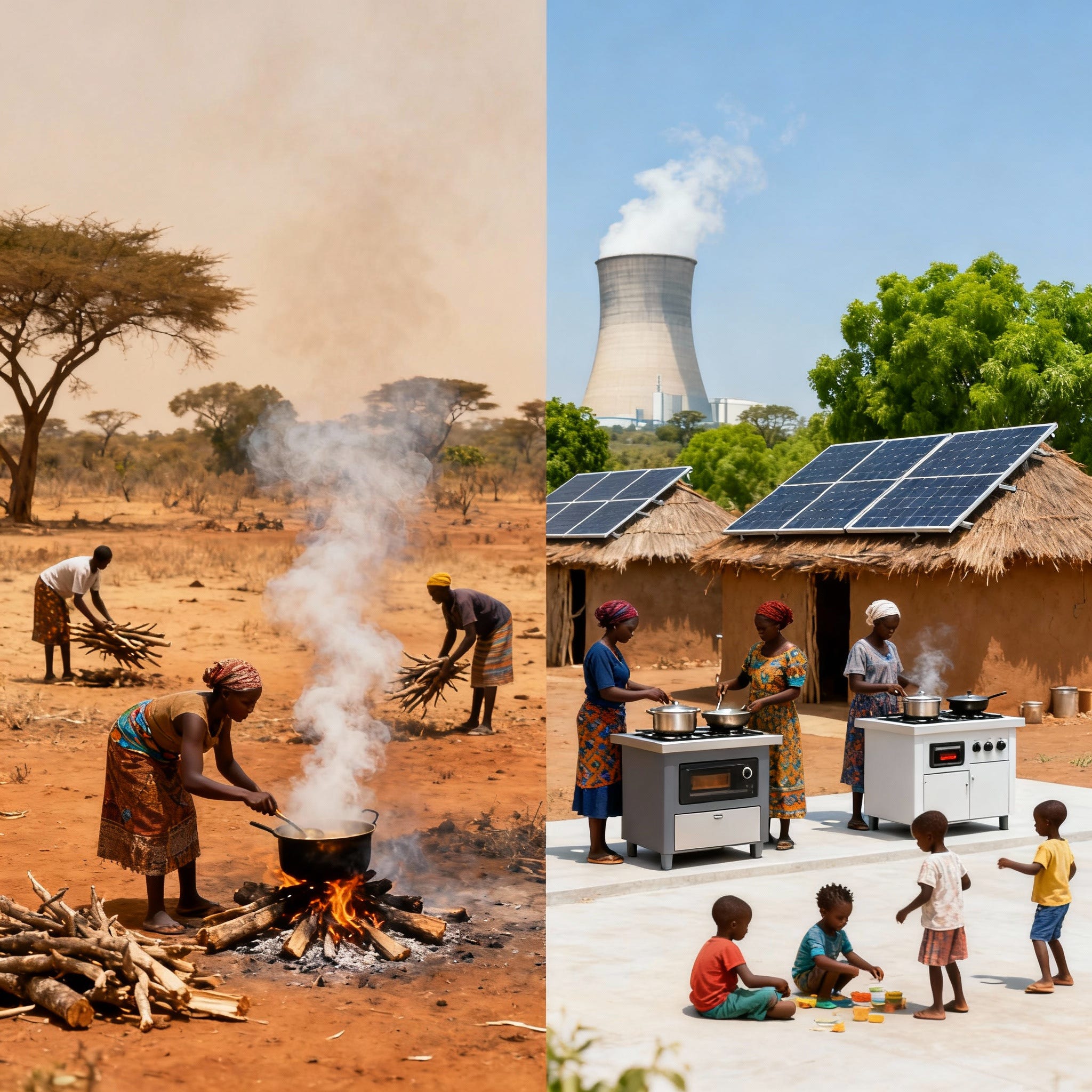
Old vs. new: biomass cooking versus clean energy (solar, LPG as a transitional solution, and nuclear) uplifting community health. AI-generated illustration for editorial purposes; no real people depicted.
Equally importantly, energy innovation isn’t about picking sides; rather, it requires a broad, pragmatic mix. Advanced renewables, nuclear power and modern fuels all have a part to play, as does local agency. The same realism is desperately needed in food and agriculture.
However, wealthy nations have repeatedly hindered real progress. For example, under pressure from Germany, the World Bank refused to fund nuclear projects in Africa for many years, thereby denying millions of people access to reliable clean energy (African Business, 2025; Africsis, 2025). Similarly, Western NGOs and government donors have blocked genetic engineering initiatives such as Golden Rice, thereby harming nutrition and health in much of the Global South. In contrast, Bangladesh’s experience with Bt brinjal demonstrates the potential of smart innovation (Golden Rice Project, 2024; Alliance for Science, 2020; PubMed, 2025; ISAAA, 2025).
The German Cautionary Tale
The German experience offers a cautionary tale. Once the “poster child” for activists, Germany has performed poorly in terms of emissions and public health metrics since closing its nuclear power stations. The German Nuclear Phase-Out Report (Anthropocene Institute, 2025) reveals that Germany’s rejection of nuclear power hindered efforts to reduce emissions and resulted in tens of thousands of premature deaths due to air pollution, as the closure of nuclear power stations led to increased reliance on fossil fuels. In numbers, this resulted in over 730 million additional tonnes of CO₂ being emitted, 19,200 premature deaths, and 177,000 cases of serious illness — stark example of how well-intentioned policies can have unintended consequences.
Furthermore, this formerly leading industrial nation now has the highest electricity prices in Europe, which are 37% above the EU average (European Commission, 2024; Clean Energy Wire, 2025; Global Petrol Prices, 2025). As of 2025, the average price of electricity for German households was €0.38–€0.39 per kWh, the highest of any major European nation. These soaring costs exacerbate inequality, battering key industries and threatening job security and competitiveness. In short, there are more emissions, more premature deaths, higher bills for the poorest in society, and a weakened economy, while profits flow to a small group of wind and solar energy producers.
These poor outcomes contrast with the original intentions and make a compelling case for a science-based, pragmatic energy and development policy that focuses on innovation and affordability. Such a policy would offer a far better path for climate and societal progress.
Rational Discourse Instead of Personal Attacks
Critiques of Gates by activists and scientists, which are often marked by personal attacks or ‘soft denial’ claims, miss the substantive point: real gains in resilience, prosperity and adaptation (McKibben, 2025; Mann, 2025). Notably, those who criticise ‘inauthentic’ pragmatism remained silent or were supportive when ample supplies of low-carbon nuclear energy were shut down, thereby undermining the core mission of mitigation.
More revealing than these rhetorical battles are the objective results. Despite high-profile disasters, data from global monitoring agencies show that deaths from climate- and weather-related hazards have plummeted over the last century. Gapminder data show a fall from 181 deaths per million people worldwide in 1900 to only 11 per million people in the 2000s — less than 6% of the historical rate (Rosling, 2018; Pinker, 2018; Gapminder). While financial losses from disasters are increasing, this is mainly due to more property and people in vulnerable areas, not reduced resilience. Human societies have become far better at weathering storms.
Climate Policy and COP30
Fossil fuels pose a major threat to public health—millions die each year from air pollution that is unrelated to climate change itself (International Energy Agency, 2025; Euronews, 2025). Yet, the grave health impacts of fossil fuels are rarely at the heart of climate activism or debate, which tends to focus primarily on temperature targets. Phasing out fossil fuels for reasons beyond climate change alone is vital, but this must be done in a way that also safeguards energy access, prosperity and resilience.
The real lesson is that compassion and evidence, not slogans, must drive climate policy. Clean cooking, pragmatic energy choices and smart food innovation are central to human dignity and planetary stewardship, not peripheral. Evidence compiled by Rosling, Pinker and others shows that progress is possible. Ahead of COP30, Bill Gates’ intervention is a timely reminder to rethink our way forward. We must reinforce balanced decision-making based on science, evidence, and reason, committing ourselves to all of humanity.
Disclaimer
This article does not claim that science itself advocates any particular course of action or set of policies. Rather, society’s priorities and goals must be collectively determined through democratic processes, ethical reflection and open debate. Science plays a vital evaluative role in this process, enabling us to rigorously assess the effectiveness of various measures in achieving societal goals, while also identifying those that may be ineffective or counterproductive (hvonstorch.de, 2022). This distinction is vital for honest and responsible decision-making in any field, including climate and development policy.
References
Alliance for Science. (2020). Anti-GMO activists convene to target Golden Rice. https://allianceforscience.org/blog/2018/04/anti-gmo-activists-convene-target-golden-rice/
African Business. (2025). End of World Bank nuclear ban paves the way for Africa. https://african.business/2025/06/energy-resources/end-of-world-bank-nuclear-ban-paves-the-way-for-africa
Africsis. (2025). World Bank lifts nuclear funding ban: what this means for Africa. https://africsis.org/?p=20339
Anthropocene Institute. (2025). The German Nuclear Phase-out Report 2025. https://anthropoceneinstitute.com/wp-content/uploads/2025/10/The-German-Nuclear-Phase-out-Report-2025.pdf
Clean Energy Wire. (2025). Germany’s household power prices 5th highest in the world – report. https://www.cleanenergywire.org/news/germanys-household-power-prices-5th-highest-world-report
Euronews. (2025). One in three people worldwide exposed to household air pollution. https://www.euronews.com/health/2025/03/19/one-in-three-people-worldwide-exposed-to-household-air-pollution-researchers-warn
European Commission. (2024). Electricity price statistics. https://ec.europa.eu/eurostat/statistics-explained/index.php?title=Electricity_price_statistics
Gapminder. Natural Disasters. https://www.gapminder.org/topics/natural-disasters/
Gates, B. (2025a). Three tough truths about climate. Gates Notes. https://www.gatesnotes.com/three-tough-truths-about-climate
Gates, B. (2025b). Bill Gates on climate memo, global health, ‘doomsday’ talk. Heatmap. https://heatmap.news/climate/bill-gates-climate-memo
GlobalPetrolPrices.com. (2025). Germany electricity prices, March 2025. https://www.globalpetrolprices.com/Germany/electricity_prices/
Golden Rice Project. (2024). The Golden Rice Project. https://www.goldenrice.org/
International Energy Agency. (2025). One billion Africans being harmed by cooking pollution. Phys.org. https://phys.org/news/2025-07-billion-africans-cooking-pollution.html
ISAAA. (2025). Bangladeshi farmers gain higher yields and profits from Bt brinjal. https://www.isaaa.org/kc/cropbiotechupdate/article/default.asp?ID=21535
Just Stop Cooking. (2025). Just Stop Cooking | Juststopcooking. https://www.juststopcooking.org/
Mann, M. E. (2025). You can’t reboot the planet if you crash it. Bulletin of the Atomic Scientists. https://thebulletin.org/2025/10/you-cant-reboot-the-planet-if-you-crash-it/
McKibben, B. (2025). Climate Gates: Maybe we don’t need billionaire opinions on everything. https://countercurrents.org/2025/11/climate-gates-maybe-we-dont-need-billionaire-opinions-on-everything/
NDTV. (2025). Climate crisis won’t lead to humanity’s demise: Bill Gates. https://www.ndtv.com/world-news/tough-truths-bill-gates-says-climate-change-wont-end-civilisation-9533827
Newsweek. (2025). Bill Gates delivers ‘tough truths’ on climate just before U.N. talks. https://www.newsweek.com/bill-gates-delivers-tough-truths-on-climate-before-u-n-talks-10951942
Pinker, S. (2018). Enlightenment now: The case for reason, science, humanism, and progress. Viking. https://stevenpinker.com/publications/enlightenment-now-case-reason-science-humanism-and-progress
PubMed. (2025). Farmers’ intention to continue Bt brinjal adoption in Bangladesh. https://pubmed.ncbi.nlm.nih.gov/40946267/
Rosling, H., Rosling, O., & Rosling Rönnlund, A. (2018). Factfulness: Ten reasons we’re wrong about the world—and why things are better than you think. Sceptre. https://www.gapminder.org/factfulness-book/
United Nations. (2024). THE 17 GOALS: Sustainable Development. http://sdgs.un.org/goals
von Storch, H. (2022). Democratic decision making and the role of (climate) science. https://www.hvonstorch.de/klima/pdf/171106.koeln.pdf
WePlanet Africa. (2025). JUSTSTOPCOOKING. https://weplanetafrica.org/project/juststopcooking/
Armadeo, I want to say thanks in particular for the 'Disclaimer' section. I spent a long time in Australian small political parties trying to explain that being evidence-based does not imply any particular policies or direction. Saying "we must follow the science" says nothing about where we must follow it to.
I stressed the point that governments can, in theory, rigorously use evidence to make their citizens' lives miserable and destroy the environment. I found it difficult to communicate that science only shows us the effect of our actions on the climate, but it's up to us to look to our values to decide how to act.